AI Agents Are Easy to Demo. Why Are They So Hard to Deploy? 25 Keynotes Reveal the Enterprise AI Challenge
 by
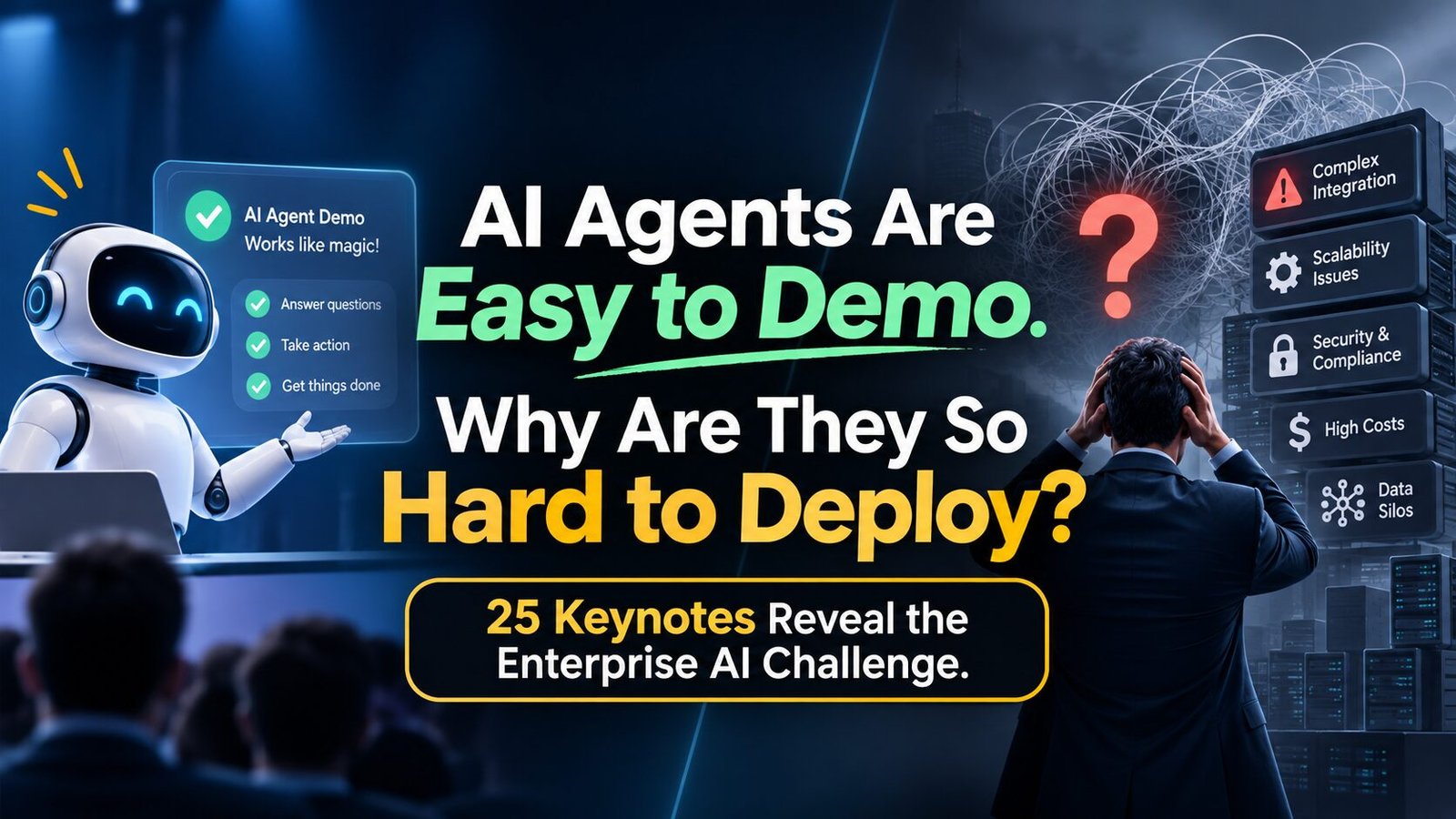
Businesses are investing in intelligent chatbots, virtual assistants and autonomous agents. But can these technologies actually resolve customer problems, reduce operating costs and deliver measurable business results? The 2026 Conversational AI & Customer Experience Summit agenda puts this question at the centre of the enterprise AI conversation.
Imagine a customer contacting a bank because a transaction has failed. An AI assistant understands the complaint, responds naturally and explains the possible reasons. But when the customer asks it to investigate the transaction, it cannot access the necessary information.
The customer is transferred to a human agent and has to explain everything again. The conversation was automated. The problem was not solved. This is the execution gap facing modern businesses. The challenge is no longer simply building AI that can talk. It is building AI that can understand context, access enterprise systems, execute authorised actions and deliver reliable outcomes.
This challenge was central to the Conversational AI & Customer Experience Summit, held on 28–29 October 2026 at H4 Hotel München Messe in Munich, Germany.
The fifth annual edition featured 25 numbered keynote sessions, three panel discussions, a fireside chat and an exclusive executive roundtable. Its programme included speakers associated with Deutsche Telekom, Vodafone, Nokia, BBVA, Booking.com, IKEA, ING, AWS, Intel, Dell Technologies, Medallia and Zalando.
Here are five important enterprise AI challenges reflected in the agenda and what businesses can learn from them.
1. The Customer Experience Gap: AI Can Answer Questions, But Can It Solve Problems?
Businesses often evaluate conversational technology through response accuracy, speed and the number of automated interactions.
Customers have a different measurement: did the interaction solve their problem?
A useful way to understand the difference is to consider three levels of automation:
AI capability | Customer outcome |
Answer | Provides information or responds to a question |
Assist | Retrieves context and guides the customer through a process |
Execute | Completes an authorised task and confirms the result |
Many organisations invest heavily in the first level while expecting the benefits of the third.
The Conversational AI & Customer Experience Summit addressed this human dimension through Nuria Pesquera García of BBVA, whose scheduled session was titled Your AI Is Smart. Your Customer Is Human. Michael McTear of Ulster University was also scheduled to discuss AI Literacy in Practice: Developing AI Capability in Northern Ireland.
The underlying lesson is that technology must serve customer expectations, not force customers to navigate complicated automated systems.
For better AI-driven Customer Experience, organisations should begin with the customer’s problem, identify the information required to resolve it and measure successful completion rather than chatbot activity.
2. Agentic AI in Customer Service: From Impressive Demonstrations to Real Business Execution
A chatbot can explain how to request a refund. An AI agent could potentially retrieve an order, check eligibility, initiate an approved refund process and confirm the outcome. That is the promise of Agentic AI in Customer Service: moving beyond conversation towards action.
However, connecting AI to real business workflows introduces challenges involving data access, permissions, integrations, accuracy and accountability.
The summit featured one of the most relevant sessions on this issue: Agentic AI: Easy to Demo, Hard to Deliver. Real-World Lessons from Building Agentic AI in Customer Service, presented in the programme by Tina Rahman of Telefónica and Olga Oskolkova of Ideabay AI.
Shahar Erez of Arato was also scheduled to present Trust Me, I’m an AI Agent: Why AI Needs Proof, Not More Promises.
These topics highlight an important distinction. An agent that performs successfully in a controlled demonstration may still fail when confronted with incomplete customer information or an unexpected business scenario.
Before deploying Agentic AI in Customer Service, enterprises should evaluate five capabilities:
- Data access: Can the agent retrieve accurate information?
- Integration: Can it work with existing enterprise systems?
- Permissions: Are its authorised actions clearly defined?
- Exception handling: Can it recognise uncertainty and escalate?
- Accountability: Can the organisation audit its actions?
The objective of Agentic AI in Customer Service should not be maximum autonomy. It should be reliable execution within clearly defined boundaries.
3. AI ROI: Are Businesses Measuring Automation or Actual Business Value?
More automated conversations do not automatically mean lower costs or better customer satisfaction. A company might reduce human-agent workload but increase repeat complaints. Another might improve response times while failing to resolve complex customer issues. This makes measurement essential to AI-driven Customer Experience.
The summit addressed the commercial side of customer experience through Martin Meyer-Gossner of Medallia, whose scheduled keynote was The ROI of CX in the Age of Agentic AI.
A second-day panel, The ROI of Customer Experience in the AI Era: Proving Business Value Beyond Customer Satisfaction, featured Gabriel Caldas Morais of The Adecco Group, Ruchi Shah of AVIV Group, Pranav Shukla of Redcare Pharmacy and Tarun Narang of Zalando, alongside Martin Meyer-Gossner. Simone Beckmann Escandón of Allianz Direct was listed as moderator.
For businesses, the practical question is how to connect customer experience improvements with measurable operational results.
KPI | What it measures |
First-contact resolution | Whether the customer’s issue is resolved immediately |
Repeat-contact rate | Whether customers need to return with the same problem |
Cost per resolution | The actual cost of successfully solving an issue |
Customer effort | How difficult it is to complete a task |
Escalation rate | How often human intervention is required |
AI action accuracy | How reliably automated tasks are completed |
Retention and conversion | Whether improved service contributes to commercial performance |
A useful calculation is:
Cost per successful resolution = Total AI and human support costs ÷ Successfully resolved cases.
This is more meaningful than counting automated conversations. The Conversational AI & Customer Experience Summit agenda makes ROI a central business consideration. For enterprises, AI-driven Customer Experience must demonstrate measurable improvements, not simply more sophisticated technology.
4. Personalisation Is No Longer Just About Recommendations. It Is About Understanding Context.
Customers expect businesses to recognise their needs, remember relevant interactions and provide consistent assistance across channels. Yet customer information is often fragmented across websites, applications, CRM platforms and support systems. The result is disconnected experiences, even when companies have substantial customer data.
The summit explored this challenge through several scheduled sessions:
- Raquel Serrano of Booking.com: CX as the Competitive Advantage in the Age of AI.
- Anton Freyberg of Nebuly AI: Expanding from AI in Support to AI-Driven Personalised User Experiences.
- Tim Stierman of IKEA: Beyond IKEA’s Smart CX Assistant: Agentic AI Analytics for the Many.
- Alfredo Lopes of Celfocus: Customers Have Picked Their Assistant, and It Isn’t the One You Built.
These topics highlight the importance of context-aware experiences. For AI-driven Customer Experience, businesses need to connect four elements:
- Customer history and relevant previous interactions.
- Current intent and the problem being addressed.
- Reliable operational information from business systems.
- The most appropriate next action.
The Conversational AI & Customer Experience Summit programme also raises an important question about external AI assistants: businesses must make their information and services accessible wherever customers choose to interact.
Personalisation should make a customer journey easier, not simply make marketing messages more targeted.
5. Human-AI Collaboration and Governance: Knowing When AI Should Stop
Not every customer interaction should be automated. Routine enquiries may be suitable for AI, while sensitive complaints, disputed transactions and complex decisions may require human judgement.
The summit addressed this through a fireside chat titled Human-AI Collaboration: Knowing When the Bot Should Stop Talking, featuring Anastasia Zdoroviak of Snoonu and Mudabir Khan of Ideabay AI.
The programme also included Jörg Kleinz of Link2AI presenting Go Live with Trust: Testing and Safeguarding Customer-Facing AI.
Another panel, The Future of Customer Experience: Will AI Become Your Best Employee or Your Biggest Business Risk?, featured perspectives from Holger Fischer of Deutsche Bank, Kristina Judina of Elisa Eesti AS, Jade Meneve of ING Nederland and David Campillo of ABB. Waqas Jutt of Intel was listed as moderator.
These discussions connect two essential requirements for Agentic AI in Customer Service: appropriate human escalation and responsible automation.
Businesses should establish identity verification, data-access controls, action permissions, audit trails and clear human handover procedures before giving AI responsibility for customer-facing tasks.
The exclusive roundtable, Beyond the Hype: Solving the Execution Gap in Agentic AI, further reinforced this implementation challenge. Its listed participants included representatives from Mercedes-Benz, Deutsche Telekom, Zalando, PUMA, Porsche Lifestyle Group, Lufthansa Group Digital Hangar and MediaMarktSaturn.
The Enterprise AI Takeaway: Build for Outcomes, Not Demonstrations
The Conversational AI & Customer Experience Summit brought together a programme covering customer trust, agentic systems, personalisation, customer experience ROI, governance and enterprise transformation.
Its 25 keynote sessions and three panels reflect a broader shift in enterprise priorities: AI adoption must move beyond experimentation towards measurable business performance. For organisations evaluating Agentic AI in Customer Service, the priorities are clear:
- Start with a real customer problem.
- Connect AI to reliable business information.
- Define permissions before enabling actions.
- Keep human oversight for sensitive situations.
- Measure resolution quality, operating costs and customer effort.
Ultimately, AI-driven Customer Experience will not be defined by how naturally a chatbot speaks or how impressive an AI demonstration looks. It will be defined by whether customers get their problems solved, employees become more effective and businesses can prove that their investment delivers value. That is the real challenge behind the next generation of enterprise AI: moving from conversations that sound intelligent to experiences that actually work.
FAQ’s
The Conversational AI & Customer Experience Summit 2026 agenda covered agentic AI, customer service automation, customer experience ROI, AI governance, personalisation, conversational analytics and human-AI collaboration. Across two days, the programme featured 25 numbered keynote sessions, three panel discussions, a fireside chat and an exclusive roundtable. The discussions focused on moving enterprise AI beyond chatbot demonstrations towards practical implementation, customer trust and measurable business outcomes.
The published speaker programme included professionals associated with BBVA, Booking.com, Deutsche Telekom, Vodafone, Nokia, IKEA, Telefónica, ING, AWS, Intel, Dell Technologies, Medallia, Qualtrics, Zalando and other organisations. Their scheduled topics covered customer experience strategy, agentic AI, enterprise transformation, AI architecture, customer intelligence and conversational technology. The programme brought together perspectives from financial services, telecommunications, retail, travel and technology.
The session was scheduled with Tina Rahman of Telefónica and Olga Oskolkova of Ideabay AI. Its focus was the practical challenge of implementing agentic AI in customer service. The topic addresses an important enterprise concern: AI agents may perform impressively in demonstrations, but production deployment requires reliable data access, business-system integration, permission controls, exception handling and measurable execution. It is particularly relevant to organisations evaluating Agentic AI in Customer Service.
Several sessions addressed the commercial value of customer experience. Martin Meyer-Gossner of Medallia was scheduled to present The ROI of CX in the Age of Agentic AI. A panel moderated by Simone Beckmann Escandón of Allianz Direct was titled The ROI of Customer Experience in the AI Era: Proving Business Value Beyond Customer Satisfaction. Its listed panellists included representatives from The Adecco Group, Medallia, AVIV Group, Redcare Pharmacy and Zalando. These topics highlighted the importance of measuring business outcomes beyond customer satisfaction scores.
The programme included a fireside chat titled Human-AI Collaboration: Knowing When the Bot Should Stop Talking, featuring Anastasia Zdoroviak of Snoonu and Mudabir Khan of Ideabay AI. The topic explored an important challenge for customer service automation: identifying when AI should handle an interaction and when a human employee should take over. It is particularly relevant for businesses deploying AI-driven Customer Experience solutions in sensitive or complex customer journeys.
The summit included Shahar Erez of Arato with Trust Me, I’m an AI Agent: Why AI Needs Proof, Not More Promises, and Jörg Kleinz of Link2AI with Go Live with Trust: Testing and Safeguarding Customer-Facing AI. Michael Kloos and Anna Mutska of CreaLog were also scheduled to discuss Beyond the Bot: Sovereign Agentic AI for Customer Service. These sessions addressed the importance of testing, safeguards and trust when deploying AI systems that interact with customers.
The programme connected technical innovation with business challenges. It covered customer experience ROI, agentic AI implementation, enterprise transformation, conversational analytics, AI governance and human-AI collaboration. With speakers associated with organisations across multiple industries, the Conversational AI & Customer Experience Summit focused on questions that matter to enterprise decision-makers: how to deploy AI responsibly, integrate it into business operations and demonstrate measurable customer and commercial value.
The 28 October 2026 roundtable was titled Beyond the Hype: Solving the Execution Gap in Agentic AI and was moderated by Nikolaus Volk of Sierra. The published participant list included organisations such as Raiffeisenbank Czech Republic, Mercedes-Benz, C&A, MediaMarktSaturn, The Adecco Group, Deutsche Telekom, Zalando, PUMA, Porsche Lifestyle Group, EnBW, Vorwerk Group, Telefónica and Lufthansa Group Digital Hangar. Its focus was the practical execution gap facing enterprise agentic AI adoption.
The agenda featured several sessions on this subject. Raquel Serrano of Booking.com was scheduled to discuss CX as the Competitive Advantage in the Age of AI. Anton Freyberg of Nebuly AI was listed for Expanding from AI in Support to AI-Driven Personalised User Experiences, while Tim Stierman of IKEA was scheduled to present Beyond IKEA’s Smart CX Assistant: Agentic AI Analytics for the Many. These topics explored how AI can support more contextual, personalised and intelligent customer journeys.
The programme highlighted that enterprise adoption involves more than building intelligent assistants. Sessions addressed real-world deployment, customer trust, sovereign AI, human oversight, analytics and business transformation. Topics such as Agentic AI: Easy to Demo, Hard to Deliver, Beyond the Bot and The Future of Customer Experience reflected the need to make AI systems reliable, accountable and operationally useful. The broader direction for Agentic AI in Customer Service is towards systems that can complete authorised tasks while maintaining appropriate human oversight.
The summit agenda identified professionals in digital transformation, customer experience, customer success, marketing, technology, innovation, product management, customer service, operations, artificial intelligence, data science and enterprise architecture as relevant audiences. It also identified industries including banking, retail, automotive, healthcare, telecommunications, hospitality, manufacturing and technology. These roles and sectors have a direct interest in evaluating AI adoption, customer engagement and business process automation.