CACES Munich 2025: A New Era of Conversational AI in Europe
 by
by 
In Asia’s rapidly expanding digital education environment, one platform has risen quickly to become Asia’s leading AI Tutor through its ability to provide students with instant assistance – QANDA by Mathpresso. Founded in South Korea, QANDA is used throughout Vietnam, Japan, Indonesia, Thailand and beyond, representing the most significant leap forward in the application of Artificial Intelligence in education – the combination of Computer Vision, Deep Learning and Conversational Artificial Intelligence into an innovative, learning-focused system for students.
Having registered over 90 million users, QANDA has 8 million active learners each month. QANDA exemplifies the future of academic support, offering a highly personalised conversational experience for users using advanced AI, especially for Mathematics. The adoption of QANDA so quickly in so many different markets is a perfect example of an innovative leader highlighted at Conversational AI Summit Asia, as Educators and EdTech Leaders, and Strategic Policymakers discuss how Artificial Intelligence will have a transformational impact on the next wave of technology.
The Rise of Voice: Human Emotion Meets Technology
As the session developed, it smoothly transitioned into voice. ElevenLabs continued the conversation by introducing the emotional prowess of Voice AI. The session was not a discussion of tools or features, but rather was about bringing identity to life. They modeled how the technology of voice can laugh, whisper, comfort, and energize. Voice transformed the interaction from digital, to humanistic experiences. The audience understood: Voice AI is not replacing people, it is amplifying them and assisting businesses in creating a richer and more empathetic Customer Experience across languages and cultures.
Travel Reinvented: Booking.com’s Blueprint for Intelligent Journeys
The narrative then shifted to the realm of travel, a realm that is always on the move. Booking.com demonstrated how Conversational AI operates quietly beneath the travels of millions of individuals every day. Their presentation showed more than just recommendations or automation; it demonstrated that intelligent systems can sense intention, foretell friction, and respond faster than travelers can type. Whether assisting someone in locating a last minute stay or investigating complex questions, the message was simple: Conversational AI allows travel to feel personal, predictable and deeply intuitive, all while supporting Booking.com’s effort towards increased Customer Experience worldwide.
Designing for Life: IKEA’s Human-Centered AI Experience
That thread of human-centred design continued effortlessly when the attention shifted to IKEA. Their storyline emerged from the home, the one place we all understand intuitively. IKEA described how they meld AI with their long-established and inalienable idea of “improving everyday life.” They illustrated how well-crafted Conversational AI and intelligent guiding systems make it easier for customers to navigate a massive ecosystem of goods. It wasn’t even about technology assisting customers; it was about technology interpreting customers in order to create improved and more significant Customer Experience at every touchpoint.
Creating Natural Conversations: Crealog’s Unified Interaction Vision
The audience had barely settled into the intuitiveness of natural human actions when Crealog continued the momentum. They effectively fused voice and text together as one, exemplifying how Voice AI and Conversational AI can coexist in natural conversation transitions. They showed how interactions with customers can be transcribed into a dynamic conversation, where systems shift in real-time and represent clarity, compassion, and importantly, precision. Crealog’s vision established a singular narrative: the ultimate Customer Experience is authentically conversational.
Technology With Heart: Panasonic’s Approach to Empathy in AI
Next, the tone switched dramatically to empathy, well-being, and sustainability. Panasonic put human softness onto the keynote stage, demonstrating how AI can serve both emotional comfort and environmental responsibility. When Panasonic introduced Nicobo, the companion robot programmed to recognize faces, react to touch, and express basic emotions, the audience felt something extremely rare at a tech conference: warmth. Panasonic reminded attendees that technology, for example, Voice AI, assistive Conversational AI systems can act as solutions and support people, creating more healthy and harmonious Customer Experience ecosystems.
Mobility Reimagined: Flix’s Evolution From NLU to Agentic AI
From emotions to efficiency, the stage next belonged to Flix, who brought the perspective of large-scale mobility and transportation. Their session charted the path from traditional NLU chatbots to agentic Conversational AI systems capable of handling complex service flows. Their journey from unsustainable manual support to scalable automation illustrated how the right architecture transforms entire Customer Experience operations. Their honesty resonated deeply: a good chatbot takes effort, context, and testing. And with the evolution of agentic systems, Voice AI and Conversational AI will redefine how brands connect with customers on the move.
Cultural Transformation: Prodyna on Building the AI-Ready Workforce
Finally, the narrative arrived at its structural backbone: implementation, culture, and workforce evolution. Prodyna, serving both as sponsor and speaker, brought a grounded, practical conclusion to the day’s storytelling. They explored the reality of building hybrid workforces, teams where humans and AI collaborate fluidly. Prodyna’s session uncovered the real blockers: poor strategy, lack of trust, and weak data foundations. They explained why so many GenAI projects fail and what organizations must do to cross from experimentation to maturity. Their perspective tied everything together: Conversational AI and Voice AI achieve their potential only when businesses build cultures and systems ready for them. And when they do, the results on Customer Experience can be transformative.
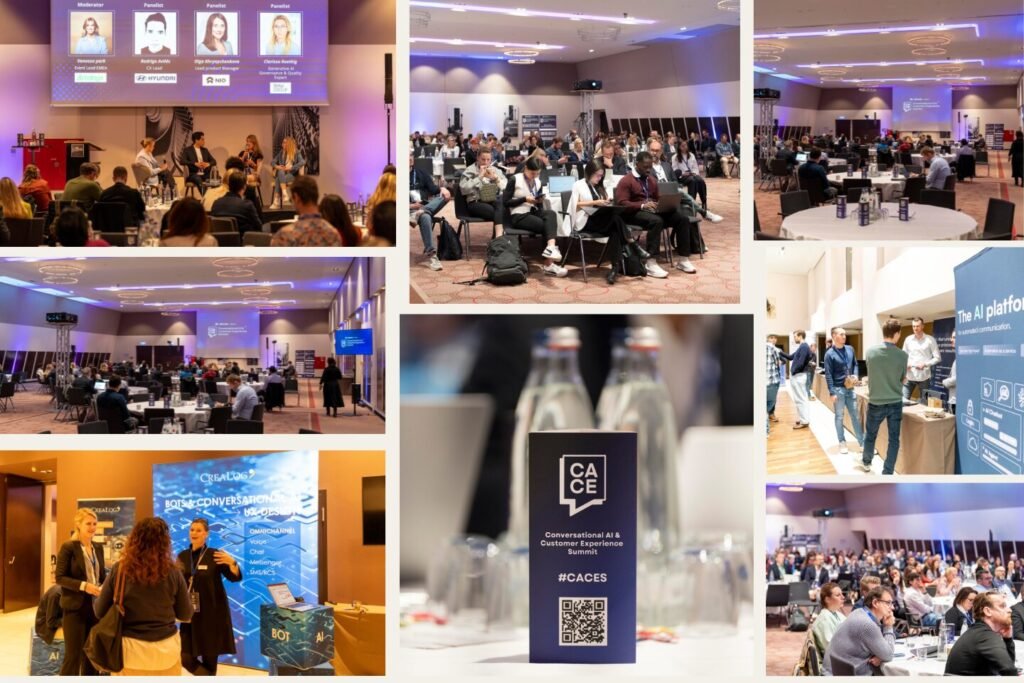
A Collective Vision for the Future
As the summit drew to a close, the audience wasn’t left with a list of tools or trends. Instead, they carried a narrative, a story of creativity, emotion, travel, design, conversation, empathy, mobility, and collaboration. A story shaped naturally through the visionary insights of Ideabay, ElevenLabs, Booking.com, IKEA, Crealog, Panasonic, Flix, and Prodyna.
The thread connecting them all was unmistakable:
AI is no longer something we simply use. It is something we build with, think with, travel with, design with, and soon, something we may even feel alongside.
It is not a technology revolution.
It is a human one powered by Conversational AI, enriched by Voice AI, and measured through the evolution of Customer Experience.
Conclusion
CACES Munich 2025 proved Europe’s moment for conversational AI and bold AI innovation. With every speaker, sponsor demo, and panel focused on deployable solutions, the summit was less about promises and more about practice. Attendees returned to their organizations ready to scale conversational systems responsibly, with governance, UX, and measurable ROI at the core.
FAQ's
It provided real world examples of Conversational AI deployments, real customer stories gathered, as well as demonstrated a case-for-business articulate success or efficiencies or improved customer experience/efficiency or AI innovation.
Conversational AI establishes customer experience through quick response times, natural interactions, and intelligent or human-like problem solving across channels.
Yes, global AI speakers shared case studies, best practices, and live demonstrations of Conversational AI in practice.
Finance, telecom, mobility, retail, public services, and healthcare shared their use cases highlighting how Conversational AI positively impacts the customer experience.
Yes, yellow hats positioned live demonstrations, expert workshops, and enterprise case studies to significantly facilitate AI development and innovation that can be re-applied immediately.
Yes, every session of the summit was focused on customer experience as it relates to automation, voice, chat, analytics, and agent-based systems.
Yes, speakers at the summit pointed out issues like data quality, privacy, scalability, and ethics, in addition to possible real-world solutions.
Yes, several different types of conversational voice technology and human avatar AI supporting post Covid customer experience were demonstrated during the summit.
– The Munich 2025 summit showcased Europe’s competitive capability in ethical AI, regulatory compliance frameworks, and large-scale deployment of AI technology.
Yes, after the success of Munich 2025, the next edition is already in the planning stages to keep driving global AI innovation.