How Ryanair Is Using AI Conversations to Handle Customer Experience at Massive Scale
 by
by 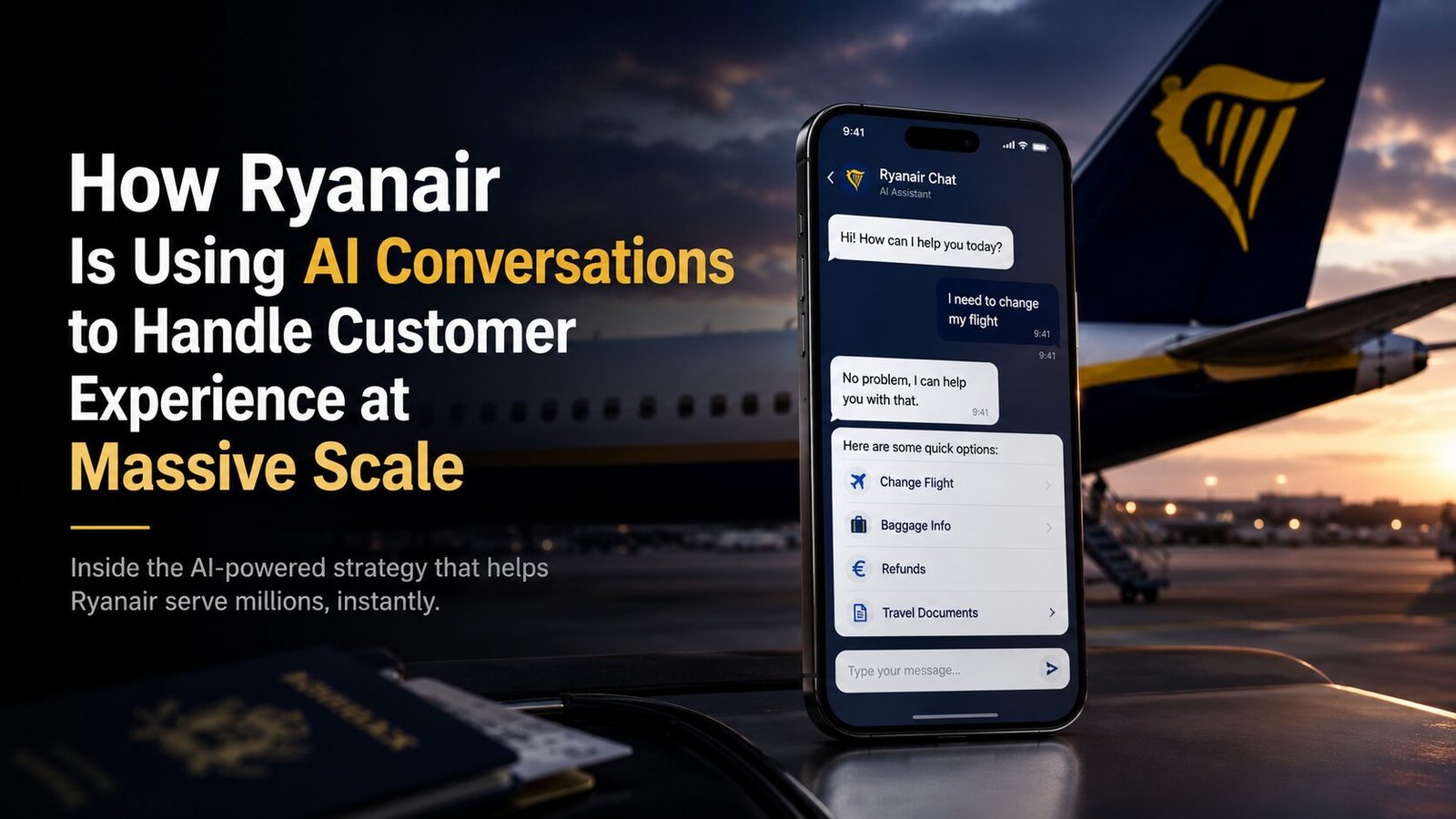
A delayed flight is frustrating.
But do you know what passengers hate even more?
Not knowing what’s happening. Not the delay. Not the cancellation. Not even the long queues.
It’s the silence that comes after. Because the moment communication stops, frustration multiplies instantly. Thousands of passengers begin checking apps, refreshing emails, flooding support systems, and searching for answers at the exact same moment. And at airline scale, that pressure spreads faster than operational problems themselves.
This is the part of aviation most people never see. Airlines don’t lose customer trust when flights are delayed. They lose it when conversations are delayed. And that’s exactly why Ryanair quietly started rethinking customer experience through Conversational AI.
Not to sound innovative. Not to follow trends. But because modern aviation no longer operates at human response speed.
Today, passengers expect immediate updates, real-time clarity, and frictionless communication during high-stress moments. This is where Conversational Experience, Real-Time Customer Communication, and scalable AI-Powered Airline Customer Service stopped being support features and became operational infrastructure. Because when millions of passengers need answers simultaneously, the companies that respond first don’t just reduce pressure. They control the entire customer experience.
Airlines Don’t Operate at Human Conversation Scale Anymore
This is the aspect most non-aviation experts would never understand. When there’s an issue in a flight, it does not only lead to dozens of questions from the customers. No, it generates thousands of emotions all happening simultaneously. The disruption results in:
- Refund requests
- Baggage concerns
- Gate confusion
- Rebooking pressure
- Social media escalation
- Support overload
All of which happen simultaneously. Communication and support channels were never built for such behavioral velocity. Human beings are sequential by nature. Customer frustration multiplies exponentially. This has been one of the largest invisible issues plaguing the aviation industry.
The Real Airline Crisis Isn’t Delay, It’s Uncertainty
Passengers can tolerate bad news surprisingly well. What they struggle to tolerate is silence. That distinction changes everything about modern airline communication.
A delayed flight with clear updates feels frustrating. A delayed flight with no communication feels chaotic. And chaos scales dangerously fast. People begin refreshing apps repeatedly. Support channels overload instantly.
Social frustration spreads publicly. Trust collapses faster than operations do.
This is why Real-Time Customer Communication is becoming more important than many operational metrics airlines historically prioritized. Because communication speed now directly shapes customer perception. And perception spreads faster than logistics. That’s the real shift happening inside aviation right now.
Ryanair Didn’t Just Improve Support, It Changed the Flow of Airline Decisions
Most businesses still believe that customer conversations come only after operational issues arise. Ryanair’s approach brings an important distinction to light. Conversations now influence how operational stressors can be managed initially. It is an enormous difference. Rather than having overburdened customer service departments sift through millions of conversations manually, the use of AI-Powered Airline Customer Service makes conversations continuous, contextual, and scalable.
No one wants to see outdated Frequently Asked Questions pages or delayed replies from an automated system. People crave instantaneity, adaptiveness, and the human touch in their conversations. This is the true meaning of modern Conversational Experience. Not chatbots. Not automation. But the power of lowering uncertainties more quickly than frustrations escalate. It becomes especially potent within the realm of aviation.
The Future of Airline Loyalty Will Be Built During Disruption
And this is the truth that airlines fail to recognize even now. Customer loyalty does not happen during seamless operations. It happens during stressful situations. During times when the customer feels:
- Confused
- Delayed
- Stranded
- Uncertain
These are the times when emotions run highest. This is why Customer Communication Automation has become one of the airline industry’s most crucial areas of investment without being fully acknowledged yet. Because disruptions will always be a part of aviation. Silence is not. The airlines of tomorrow are not those which solve operational problems. They are the ones which decrease emotional turbulence quicker than their rivals.
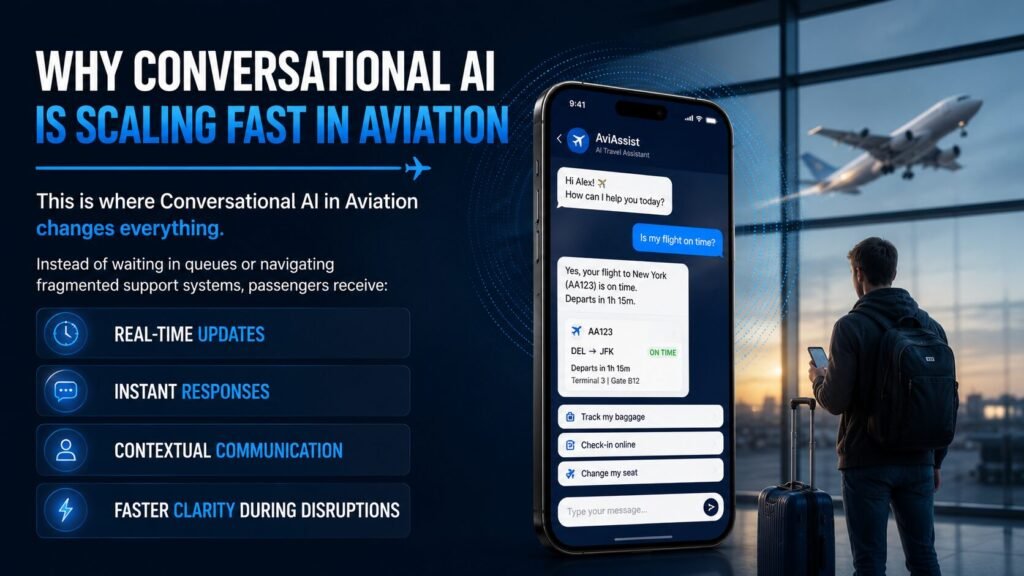
Why Aviation Became the Perfect Industry for Conversational AI
Few industries combine:
- Emotional urgency
- Real-time unpredictability
- Operational volatility
- Massive communication pressure
Every minute changes something:
- Weather
- Routes
- Timing
- Staffing
- Gate availability
- Customer sentiment
Static communication systems struggle in environments like this because static systems assume stability. Airlines rarely operate in stability. This is why Conversational AI in Aviation is evolving faster than many enterprise sectors. It adapts dynamically, scales instantly, and communicates continuously under pressure. That changes how customer experience works entirely. Because passengers no longer judge airlines only by whether disruptions happen. They judge them by how intelligently companies respond when they do.
The Biggest Shift Isn’t Technological, It’s Psychological
Most companies consider Conversational AI to be a support technology. But the reality is that it is a behavioral phenomenon. Consumers can no longer differentiate between performance and communications. They consider
- slow response = poor experience
- silence = operational failure
- confusion = lack of trust
This is precisely why the new Conversational Experience will turn into a psychological dimension of the customer experience, rather than a purely technological one. The objective is no longer merely about replying more swiftly. The aim is stabilizing customer trust instantly. And doing so on Ryanair’s scale turns into an operational revolution.
Why Industry Leaders Are Paying Close Attention
The changes that have been happening within aviation are no longer just confined to airlines alone. The whole high pressure industry is starting to feel the same communication revolution taking place:
- Finance
- Healthcare
- Logistics
- Telecommunications
- Retail
The demand from customers is growing much faster than traditional service models can adapt to. This is precisely the reason why talks about scalable Conversational AI, intelligent CX, and real-time communication platforms are now becoming increasingly relevant at conferences such as the Conversational AI & CX Summit Europe. This is because customer experience in the future is not just about your products or even your prices anymore. It is all about responsiveness.
Final Insight: Passengers Remember the Response Longer Than the Delay
For years, airlines competed through pricing, routes, and operational scale. But something much bigger has quietly changed. Passengers no longer remember only the flight. They remember the communication around it.
They remember:
- how fast the response came
- whether updates felt clear
- whether someone seemed present during uncertainty
And in modern aviation, that emotional experience now shapes trust faster than operational performance itself. This is why Conversational AI, scalable Customer Communication Automation, and intelligent Conversational Experience systems are no longer optional for airlines operating at massive scale. They are becoming the difference between brands that absorb pressure, and brands that amplify it.
Ryanair understood this early.
Because when disruption happens, passengers don’t expect perfection anymore. They expect responsiveness. And the airlines learning how to deliver real-time reassurance through Conversational AI in Aviation are not just improving customer support. They are quietly redesigning what customer experience means in the airline industry itself.
That’s exactly why conversations around scalable communication systems, AI-Powered Airline Customer Service, and the future of Real-Time Customer Communication are becoming central at the Conversational AI & Customer Experience Summit Europe, because the next leaders in aviation won’t be defined only by how efficiently they move aircraft. They’ll be defined by how intelligently they move conversations.
FAQ's
Airlines are rapidly adopting Conversational AI because modern passengers expect instant communication during delays, cancellations, and disruptions. Traditional support systems cannot handle massive volumes of real-time customer queries at airline scale. With intelligent automation and faster responses, airlines can improve Conversational Experience, reduce customer frustration, and deliver seamless support during high-pressure moments.
Ryanair is using Conversational AI in Aviation to deliver faster updates, automate high-volume customer interactions, and provide real-time assistance during operational disruptions. Instead of relying only on overloaded support teams, the airline is scaling AI-Powered Airline Customer Service to improve response speed, reduce uncertainty, and enhance customer trust.
In aviation, delays create emotional pressure instantly. Passengers want immediate clarity regarding flight status, gate changes, refunds, and rebooking options. Real-Time Customer Communication helps airlines reduce confusion, control frustration, and maintain customer confidence during unpredictable situations.
The biggest challenge is no longer flight delays alone, it is delayed communication. Passengers can tolerate disruptions when updates are clear and timely. However, silence increases uncertainty and damages trust rapidly. This is why scalable Customer Communication Automation has become essential for modern airlines.
Conversational AI automates repetitive queries, handles high interaction volumes instantly, and provides continuous support across multiple channels. This allows airlines to reduce support overload, improve operational efficiency, and deliver a smoother Conversational Experience without increasing manual workload.
European airlines operate in highly dynamic environments with constant schedule changes, weather disruptions, and large passenger volumes. Conversational AI in Aviation helps airlines manage communication pressure at scale while improving response times, customer engagement, and operational resilience.
Passengers trust airlines more when communication feels immediate, transparent, and consistent. AI-Powered Airline Customer Service ensures travelers receive timely updates and contextual responses, reducing uncertainty during stressful travel moments and strengthening customer confidence.
Modern passengers expect communication that feels fast, intelligent, and frictionless. A strong Conversational Experience helps airlines guide customers smoothly through delays, cancellations, and support interactions while minimizing frustration and improving overall satisfaction.
Airline leaders are focusing on scalable communication systems because customer expectations are evolving rapidly. Discussions around Conversational AI, automation, and intelligent customer engagement are becoming central at events like the Conversational AI & Customer Experience Summit Europe, where businesses explore the future of real-time customer communication.
The future of aviation customer experience will be defined by responsiveness, not just operational efficiency. Airlines that scale Conversational AI, improve Real-Time Customer Communication, and deliver intelligent Conversational Experience systems will gain a major competitive advantage in the evolving airline industry.