Google Turned Search Into an AI Agent. Here’s Why This Changes Conversational AI Forever
 by
by 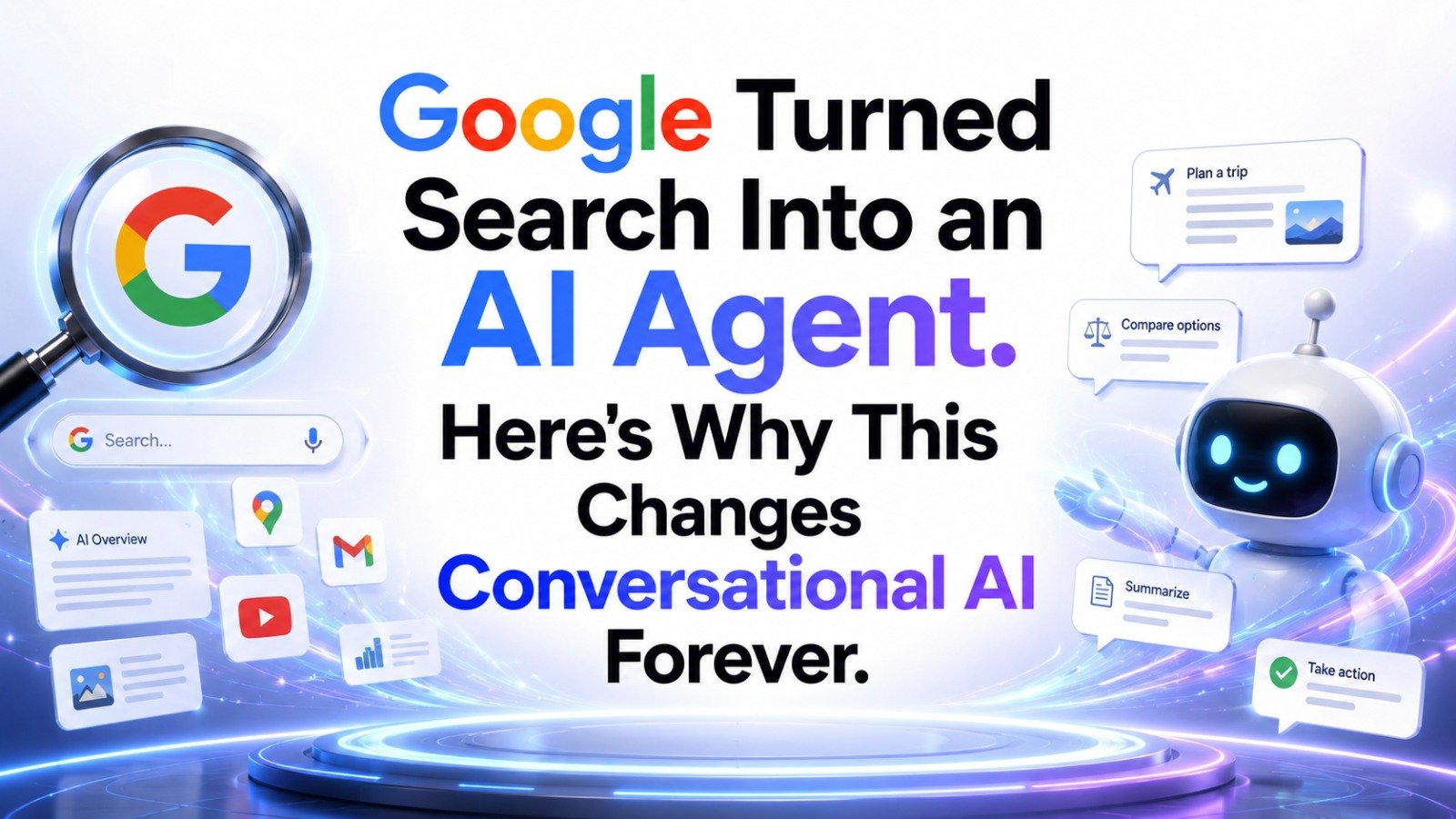
Google’s AI Mode now connects with Instacart, Canva, and YouTube Music. But the real story is much bigger. Search has officially evolved from answering questions to completing tasks. Here’s what that means for Conversational AI, Agentic AI, enterprises, and the future of the internet.
Google Didn't Launch a Feature. It Changed the Definition of Search.
For nearly three decades, Google Search has followed one simple rule.
You search. Google finds. You decide.
Every search session ended with a list of links, leaving the actual work to the user.
That rule has now been broken.
On July 16, 2026, Google announced Connected Apps for AI Mode, allowing users to securely connect services like Instacart, Canva, and YouTube Music directly inside Search. Instead of only generating answers, AI Mode can now take actions on a user’s behalf. It can build an Instacart cart from a recipe, surface Canva templates for a design brief, or create and save playlists in YouTube Music, all from a single conversation. The rollout began for U.S. users using AI Mode in English.
At first glance, this looks like another AI product update.
It isn’t.
This is Google’s clearest signal yet that Search is evolving from an information retrieval system into an intelligent execution platform.
That distinction matters because it changes what users expect from AI and what businesses need to build next.
The Internet Has Entered the Action Era
Every major technology platform has had its defining moment. The web-connected documents. Search connected information. Social media connected people. Smartphones connected apps. Generative AI connected language.
Now Agentic AI is connecting intent with execution. This is where Google’s announcement becomes historically significant.
For the first time, billions of people will experience an AI system that doesn’t stop after answering a question. It actually begins working.
Instead of saying,
“Here are ingredients for tacos.”
Google can now say,
“I’ve already added everything to your Instacart cart.”
Instead of suggesting design ideas, it opens Canva with templates matching your prompt. Instead of recommending songs, it builds and saves an actual playlist. The conversation becomes the interface. The task becomes the outcome.
That is the defining characteristic of Agentic AI.
Google Has Quietly Changed the Competitive Landscape
Most media coverage compared this announcement with ChatGPT. That comparison misses the point. Google is no longer competing only against AI chatbots. It is competing to become the operating system for human intent. Think about Google’s position today. It already owns or operates:
- Search
- Chrome
- Android
- Gmail
- Maps
- Workspace
- YouTube
- Gemini
Now imagine every one of those products connected through a reasoning engine capable of taking actions across both Google and third-party services. This is no longer a search engine. It is an orchestration layer for digital work.
Google even confirmed that more Connected Apps and ecosystem partners are on the way, indicating that Instacart, Canva, and YouTube Music are only the first wave.
The Four Eras of Google Search
Understanding why this matters requires looking at how Search has evolved.
|
Era |
User Goal |
Google’s Role |
|
Search 1.0 |
Find websites |
Index the web |
|
Search 2.0 |
Find answers |
Understand language |
|
Search 3.0 |
Generate responses |
Reason with AI |
|
Search 4.0 |
Complete tasks |
Act as an AI agent |
This latest shift is the biggest architectural change since Google’s launch in 1998. For the first time, Search owns part of the workflow, not just the discovery process. That changes everything.
Why This Is Bigger Than AI Overviews
Many people assume AI Overviews were Google’s biggest AI innovation. They weren’t. AI Overviews changed how answers are displayed. Connected Apps change what Search is capable of doing. That is a much larger leap. The difference looks like this:
Yesterday
Question → AI Answer → User Opens Another App → User Completes Task
Today
Question → AI Reasoning → Connected App → Task Prepared → User Confirms
Notice what disappeared.
Three separate steps. That reduction in friction is exactly what successful technology products have always optimized for.
This Is What Agentic AI Actually Looks Like
The phrase Agentic AI has become one of the most overused terms in artificial intelligence. Every AI company claims to build AI agents. Very few actually do. An AI assistant that summarizes emails is still reactive. An AI chatbot that answers questions is still reactive. An AI system becomes agentic when it can:
- Understand intent
- Plan multiple steps
- Use external tools
- Coordinate applications
- Return with completed work
- Ask for confirmation when needed
Google’s Connected Apps demonstrate this model in a consumer product used by billions. That is why this announcement deserves attention from every company building Conversational AI.
Why Conversational AI Is About to Change Forever
For years, most Conversational AI platforms optimized for one metric. Response quality. Large language models became better at explaining, summarizing, translating, brainstorming, and writing. But users don’t ultimately pay for explanations. They pay for outcomes. That changes the design philosophy entirely. The next generation of Conversational AI will be judged by questions like:
- Did it book the meeting?
- Did it order the groceries?
- Did it update the CRM?
- Did it schedule the appointment?
- Did it generate the campaign assets?
- Did it finish the workflow?
The conversation is becoming invisible. Execution is becoming the product.
Why Enterprises Should Be Paying Attention Right Now
Google’s announcement may appear consumer-focused. It isn’t. Every enterprise AI vendor should view this as a blueprint.
Imagine a customer asking,
“My shipment hasn’t arrived.”
Traditional chatbot:
“Here is our shipping policy.”
Modern Conversational AI:
- Looks up the order
- Verifies identity
- Checks warehouse systems
- Generates replacement options
- Creates a support ticket
- Schedules delivery
- Sends confirmation
Same conversation. Completely different business value. This is why Gartner predicts that agentic capabilities will become a defining characteristic of enterprise AI platforms over the coming years, as organizations move beyond copilots toward systems that can execute multi-step work.
The Data Explains Why Google Is Moving So Fast
Google is not making this shift in isolation. The economics of AI strongly support moving from information to execution.
According to McKinsey, generative AI has the potential to create $2.6 trillion to $4.4 trillion in annual economic value across dozens of business functions, with much of that value coming from automating knowledge work rather than simply generating text. (Source: McKinsey, The Economic Potential of Generative AI)
Meanwhile, Google’s Connected Apps strategy directly targets high-frequency, real-world workflows such as shopping, media, planning, and creative work. Rather than replacing specialized apps, AI Mode orchestrates them through natural language, reducing friction while keeping users inside Google’s ecosystem.
FAQ's
Connected Apps allow Google AI Mode to securely interact with supported third-party services such as Instacart, Canva, and YouTube Music. Instead of only answering questions, AI Mode can initiate real tasks inside those apps while keeping the user in control of final confirmation.
Conversational AI focuses on understanding and responding to human language. Agentic AI goes a step further by planning, reasoning, using external tools, and completing multi-step tasks across applications.
Businesses can move beyond FAQ chatbots and deploy AI systems that automate customer service, sales, operations, and internal workflows. This reduces manual effort, improves customer experience, and creates measurable operational efficiency.
Marketers should create high-quality, structured, and authoritative content optimized for SEO, GEO, AEO, and LLMO. The goal is not just to rank in search results but to become a trusted source that AI systems reference when generating answers and taking actions.
Google AI Mode shifts the focus from ranking web pages to becoming a trusted source for AI-generated answers. Businesses should invest in high-quality, authoritative content optimized for SEO, GEO (Generative Engine Optimization), AEO (Answer Engine Optimization), and LLMO (Large Language Model Optimization).
Businesses should move beyond FAQ chatbots and build Conversational AI solutions that can integrate with CRMs, payment systems, calendars, and enterprise software. The future of customer experience lies in AI that completes tasks, not just answers questions.
Not entirely. ChatGPT and Claude remain powerful general-purpose AI assistants. However, Google AI Mode has a unique advantage because it is deeply integrated with Google Search and connected services, allowing it to combine information retrieval with real-world task execution.
Connected Apps represent a major shift from AI assistants that provide information to AI systems that perform actions. This evolution is expected to influence how enterprises build AI products, how users interact with Search, and how businesses optimize content for AI-powered search experiences.