Microsoft’s Project Perception vs. Anthropic’s Mythos: Why the Next AI War Is About Systems, Not Models
 by
by 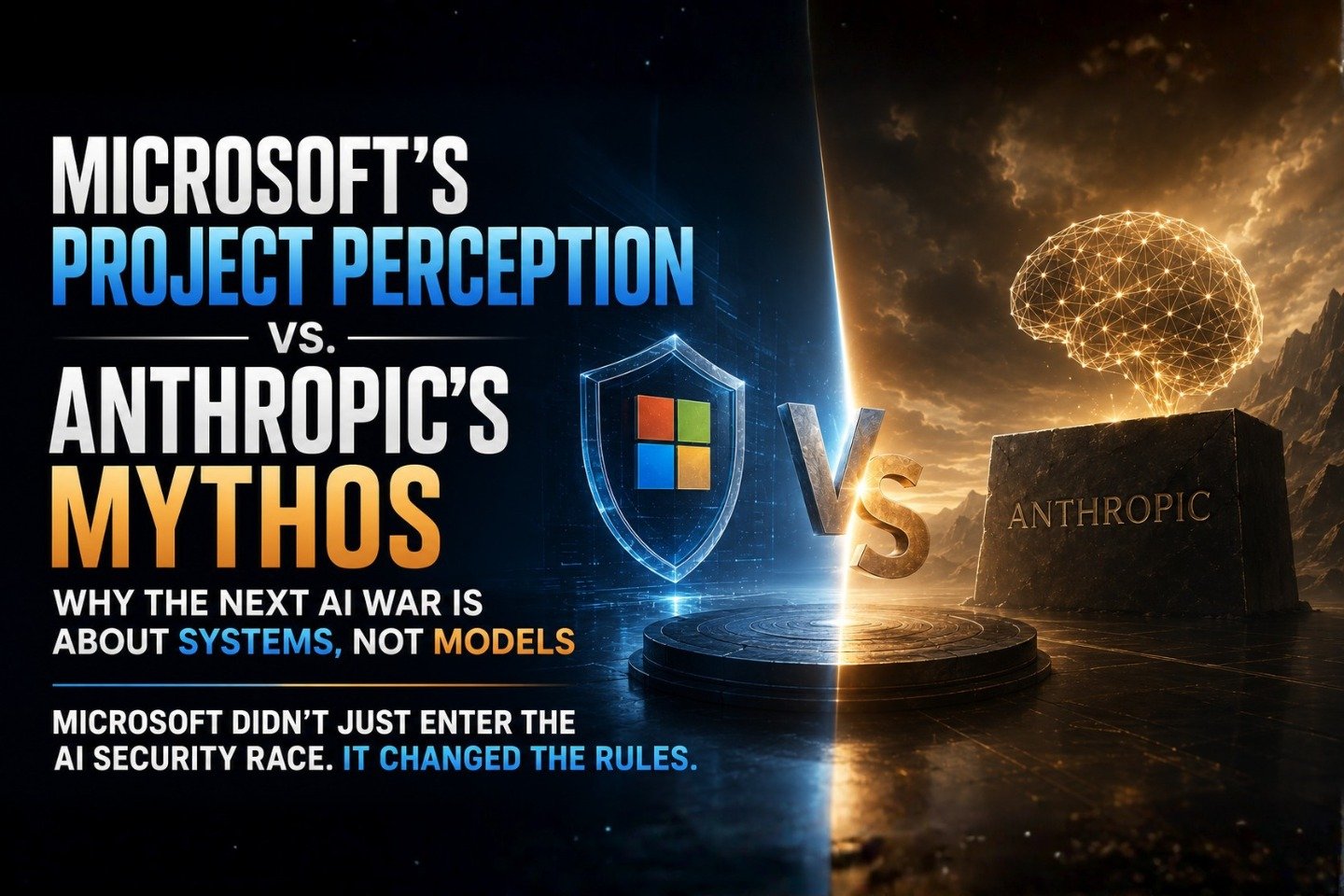
Microsoft Didn’t Just Enter the AI Security Race. It Changed the Rules.
For the past three years, the AI industry has been obsessed with one question.
Who has the smartest model?
OpenAI chased larger reasoning models. Anthropic focused on safer frontier intelligence. Google invested heavily in Gemini. Meta open-sourced increasingly capable Llama models. Every major AI lab competed on benchmarks, reasoning scores, coding performance, and context windows.
Now Microsoft appears to be asking a completely different question.
What if the future of enterprise AI isn’t built on one powerful model, but on an intelligent system that knows when to use many models?
That is the idea behind Microsoft’s reported Project Perception, an AI-powered cybersecurity platform designed to discover software vulnerabilities using a multi-model architecture. According to recent reporting, Project Perception combines models from Microsoft, OpenAI, and Anthropic to identify security flaws, recommend fixes, and reduce the cost of advanced AI-powered security analysis. Microsoft has not officially announced the product, but multiple outlets report that it is expected to launch before the end of July.
On the other side of this emerging rivalry is Anthropic’s Mythos Preview, one of the most advanced cybersecurity-focused AI models ever built. Unlike traditional large language models, Mythos was developed for identifying and reasoning about software vulnerabilities. Anthropic has intentionally restricted access through Project Glasswing, limiting availability to a small group of trusted organizations working on critical software security.
At first glance, this looks like another Microsoft versus Anthropic story. It isn’t.
The real story is that enterprise AI is shifting from frontier models to intelligent AI systems. That shift could redefine the future of Conversational AI, Agentic AI, and enterprise cybersecurity over the next decade.
Is the AI Industry Entering Its Second Phase?
The first wave of generative AI rewarded companies that built the most capable language models. The second wave will reward companies that build the best AI systems.
Those are two very different challenges. A frontier model answers questions.
An AI system plans work, selects the right tools, coordinates multiple models, verifies results, and completes complex tasks. Think about how an enterprise security team operates today. Finding a critical vulnerability is rarely a one-step process. A security engineer may need to:
- Scan millions of lines of code
- Prioritize high-risk vulnerabilities
- Verify whether a flaw is exploitable
- Generate a secure patch
- Test the fix
- Document the change
- Notify development teams
Each of these tasks requires different capabilities. Instead of forcing one large model to handle everything, Microsoft’s reported approach uses model routing, assigning different security tasks to the AI model best suited for each stage of the workflow.
That is a significant architectural shift. It treats AI less like a chatbot and more like an enterprise operating system.
What Is Microsoft's Project Perception?
Although Microsoft has not yet published official technical documentation, multiple reports describe Project Perception as an AI-powered vulnerability detection platform designed for enterprise software development. According to current reporting, Project Perception aims to:
- Detect software vulnerabilities automatically
- Recommend or generate secure code fixes
- Route different tasks across Microsoft, OpenAI, and Anthropic models
- Reduce inference costs through intelligent model selection
- Make advanced AI-powered security analysis more accessible to enterprises
Unlike traditional static security scanners, the reported architecture focuses on reasoning rather than pattern matching. Instead of simply identifying suspicious code, the platform is expected to analyze whether a vulnerability is genuinely exploitable and recommend practical remediation steps.
If these reports prove accurate, Project Perception would represent one of Microsoft’s most ambitious enterprise AI security initiatives since GitHub Copilot.
Anthropic's Mythos Is Solving a Different Problem
Anthropic has taken a very different approach. Rather than building a broadly available enterprise platform, the company created Claude Mythos Preview for a limited cybersecurity initiative known as Project Glasswing.
Project Glasswing brings together organizations including Amazon Web Services, Apple, Cisco, CrowdStrike, Google, Microsoft, NVIDIA, JPMorganChase, and the Linux Foundation to secure critical software infrastructure.
According to Anthropic, Mythos demonstrated the ability to discover previously unknown vulnerabilities across major operating systems and web browsers during internal testing. Independent evaluations also showed impressive cyber reasoning performance.
The UK AI Security Institute reported that Mythos became the first model to complete the 32-step “The Last Ones” cyber range end-to-end in multiple attempts. Mozilla later announced that it identified and patched 271 Firefox vulnerabilities with assistance from Mythos Preview.
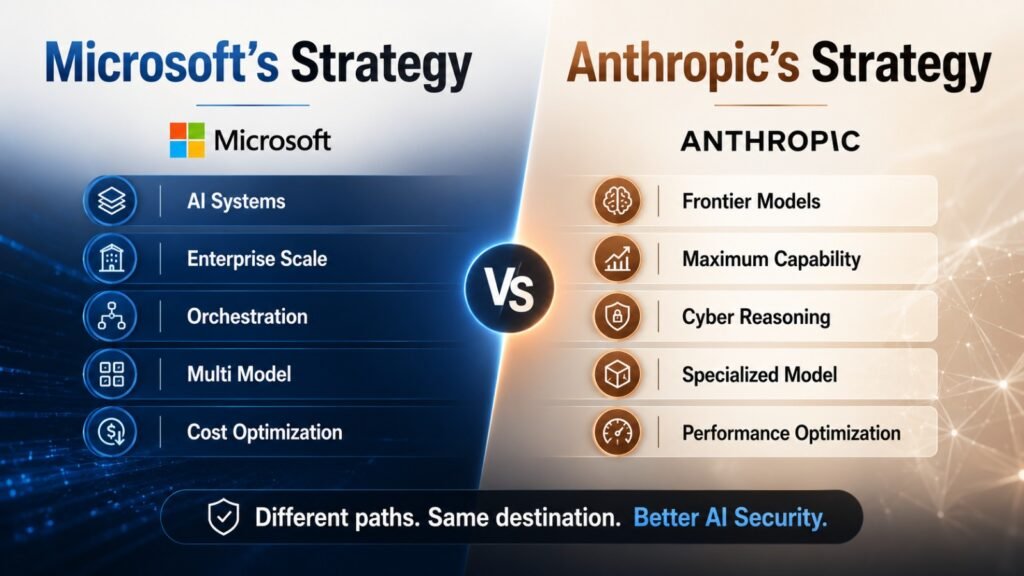
Those results suggest that Anthropic is pushing the frontier of AI-assisted cybersecurity rather than pursuing mass-market deployment. That distinction matters. Microsoft appears focused on scaling enterprise adoption. Anthropic appears focused on maximizing frontier capability.
Models vs. Systems: The Real Competitive Shift
Most discussions compare Project Perception and Mythos as if they were competing AI models. That comparison misses the bigger transformation. The competition is no longer about building one model that outperforms every other model. It is about building an AI system that consistently delivers better business outcomes. Consider the difference.
|
Traditional AI Model |
Modern AI System |
|
Answers questions |
Completes workflows |
|
Optimized for benchmarks |
Optimized for outcomes |
|
Single reasoning engine |
Multiple specialized models |
|
One response |
Continuous orchestration |
|
Intelligence first |
Execution first |
This distinction explains why Agentic AI has become one of the fastest-growing areas of enterprise AI. Organizations are no longer asking,
“Which model has the highest benchmark score?”
They’re asking,
“Which AI system helps my teams solve real problems faster, more securely, and at a lower cost?”
That is a far more valuable question.
Why This Matters for Agentic AI
For years, the term Agentic AI has been used loosely to describe almost any advanced AI assistant. In reality, an AI agent must do much more than generate text.
A true agent needs to:
- Understand user intent
- Break complex work into multiple steps
- Decide which tools to use
- Coordinate external systems
- Verify outputs
- Adapt when conditions change
Project Perception’s reported multi-model architecture reflects exactly this direction. Instead of assuming one model excels at everything, it treats AI as a coordinated network of specialized capabilities working together toward a common goal. That approach aligns closely with where enterprise Agentic AI is heading.
The next generation of AI will not be remembered for producing better paragraphs. It will be remembered for completing better workflows.
Why Conversational AI Is Entering a New Era
This shift also has profound implications for Conversational AI. For the past decade, most conversational systems focused on improving dialogue quality. Better natural language understanding. Better response generation. Better customer satisfaction. Those capabilities remain important.
But enterprises increasingly expect Conversational AI to become the entry point for executing work rather than simply discussing it. Imagine a developer reporting a suspected security issue. Yesterday’s assistant would explain the vulnerability. Tomorrow’s assistant could:
- Analyze the repository
- Launch an AI security scan
- Prioritize the findings
- Generate a proposed fix
- Create a pull request
- Notify the engineering team
The conversation is only the beginning. Execution becomes the real product.
Microsoft and Anthropic Are Solving Different Enterprise Problems
At first glance, Project Perception and Mythos appear to compete in the same category. Both apply AI to cybersecurity. Both target enterprise customers. Both aim to detect vulnerabilities faster than traditional security tools. Look closer, and a different picture emerges.
Microsoft appears to be building a scalable enterprise platform. Anthropic is building a frontier cyber reasoning model. That difference will likely influence how enterprises evaluate AI investments over the next few years. A global bank, for example, does not simply need the smartest AI model. It needs an AI system that integrates with GitHub, Azure DevOps, Microsoft Defender, SIEM platforms, identity management systems, ticketing software, and compliance workflows.
This is where Microsoft’s ecosystem becomes a strategic advantage. By combining cloud infrastructure, developer tools, enterprise software, and AI, Microsoft can potentially transform AI Security from an isolated capability into an integrated workflow. Anthropic, on the other hand, is pushing the boundaries of what a specialized reasoning model can accomplish.
Its success could redefine the upper limit of AI-assisted cybersecurity. Microsoft’s success could redefine how enterprises deploy AI at scale. Those are complementary strategies rather than identical ones.
The Rise of Multi-Model AI Systems
The first generation of enterprise AI followed a simple formula. One chatbot. One model. One conversation. That architecture is already beginning to show its limits. Modern enterprise workflows require different capabilities at different stages. Consider how a software vulnerability is resolved. The workflow may involve:
- Code analysis
- Threat intelligence
- Exploit validation
- Patch generation
- Compliance checks
- Documentation
- Human approval
Expecting one model to excel equally across every stage is inefficient. This is why the industry is moving toward multi-model orchestration. Instead of asking:
“Which AI model is the smartest?”
Organizations are increasingly asking:
“Which combination of AI models produces the best business outcome?”
That subtle shift could become one of the defining characteristics of Agentic AI.
Why This Changes Conversational AI
The evolution of Conversational AI is no longer about making conversations feel more natural. It is about making conversations more productive. Think about how enterprise chatbots traditionally operate. A user asks a question. The chatbot searches for documentation. It generates an answer. The conversation ends. The next generation of Conversational AI works differently. The conversation becomes the trigger for an entire workflow. Imagine asking:
“Can you investigate today’s critical vulnerabilities?”
Instead of returning a report, an AI system could:
- Scan the latest code commits.
- Correlate findings with known threat intelligence.
- Prioritize vulnerabilities by business impact.
- Generate secure remediation suggestions.
- Open engineering tickets.
- Notify the security team.
The user receives outcomes rather than explanations. That is the real promise of Agentic AI.
Why AI Security Is Becoming the Next Enterprise Battleground
Cybersecurity is one of the most promising applications of enterprise AI because the challenges are becoming too large for human teams alone. Modern organizations manage:
- Millions of lines of source code
- Thousands of software dependencies
- Expanding cloud infrastructure
- Constant vulnerability disclosures
- Increasingly sophisticated cyberattacks
According to the IBM Cost of a Data Breach Report 2024, the average global cost of a data breach reached $4.88 million, the highest level recorded at the time of the report. (Source: IBM Cost of a Data Breach Report 2024)
Meanwhile, Verizon’s 2025 Data Breach Investigations Report found that exploitation of vulnerabilities remains one of the fastest-growing initial access methods for attackers, highlighting the importance of reducing the time between vulnerability discovery and remediation. (Source: Verizon DBIR 2025)
These trends explain why AI Security has become a strategic priority rather than an experimental initiative. Organizations are no longer asking whether AI belongs in cybersecurity. They are asking how quickly they can deploy it responsibly.
What This Means for Enterprise Leaders
Enterprise decision-makers should avoid focusing exclusively on benchmark scores.
Instead, they should evaluate AI platforms across five practical dimensions.
1. Integration
Can AI work across existing enterprise systems?
2. Security
Does it respect governance, permissions, audit trails, and compliance requirements?
3. Reasoning
Can it solve complex, multi-step problems instead of generating isolated responses?
4. Automation
Can it complete workflows with appropriate human oversight?
5. Scalability
Can it deliver those capabilities cost-effectively across thousands of employees?
These questions matter far more than whether one model scores two percentage points higher on a benchmark.
What This Means for SEO, GEO, AEO, and LLMO
The rise of Agentic AI is not only changing software.
It is changing how businesses are discovered.
Traditional SEO focused on ranking web pages.
The emerging AI ecosystem requires something broader.
SEO
Ensure content remains technically sound, authoritative, and easy to crawl.
GEO (Generative Engine Optimization)
Publish structured, fact-based content that AI systems can accurately summarize.
AEO (Answer Engine Optimization)
Provide direct, evidence-backed answers to high-intent questions.
LLMO (Large Language Model Optimization)
Use clear entities, trustworthy sources, expert insights, and logical structure so large language models can confidently retrieve and reference your content.
As AI assistants become the first stop for research, businesses must optimize for both humans and machines. Authority will become just as important as visibility.
Five Predictions for the Future of Agentic AI
1. Multi-model systems will outperform single-model deployments.
Organizations will combine specialized models instead of relying on one general-purpose system.
2. AI Security will become a standard enterprise capability.
Just as endpoint protection became essential, AI-assisted vulnerability management will become part of every modern security stack.
3. Conversational AI will evolve into workflow orchestration.
The most valuable assistants will execute business processes rather than simply answering questions.
4. Human oversight will remain essential.
The future is not autonomous AI replacing experts.
It is AI accelerating experts while preserving accountability for critical decisions.
5. Competitive advantage will come from systems.
The companies that win the next decade will not necessarily own the smartest model.
They will build the smartest combination of models, tools, data, and workflows.
Final Thoughts
The headlines suggest Microsoft and Anthropic are entering another AI rivalry. The deeper story is much more important. The industry is moving beyond comparing language models. It is beginning to compare AI systems.
Project Perception reportedly represents Microsoft’s vision of scalable, integrated AI Security. Mythos represents Anthropic’s pursuit of frontier cyber reasoning. Both approaches matter. Together, they point toward the next chapter of enterprise AI.
For businesses investing in Conversational AI, the message is clear. Customers will increasingly expect AI to complete meaningful work, not simply provide information. For organizations investing in Agentic AI, success will depend on orchestrating models, tools, and enterprise systems into reliable workflows.
The companies that recognize this transition early will build products that solve real business problems instead of chasing benchmark leadership. The next AI revolution is unlikely to be defined by one breakthrough model. It will be defined by intelligent systems that combine reasoning, execution, security, and trust into a single enterprise experience.
FAQ's
Project Perception is a reportedly upcoming Microsoft AI Security initiative focused on identifying software vulnerabilities using a multi-model architecture. While Microsoft has not yet released detailed technical documentation, industry reports indicate it is designed to combine models from multiple providers to improve security analysis and reduce costs.
Mythos Preview is Anthropic’s specialized cybersecurity model, available through Project Glasswing to a limited group of organizations working on critical software and infrastructure security.
Based on current public information, Project Perception emphasizes enterprise-scale orchestration and model routing, while Mythos focuses on advanced cyber reasoning capabilities. They address different aspects of AI Security rather than serving as identical products.
Modern Conversational AI is evolving beyond answering questions. Enterprise assistants are increasingly expected to initiate workflows, integrate with business systems, and help complete tasks through natural language interactions.
Agentic AI enables AI systems to reason, plan, use tools, and execute multi-step workflows with human oversight. This can improve productivity, reduce manual effort, and accelerate complex business processes.
Organizations should invest in trusted data, secure integrations, governance frameworks, and AI platforms that can coordinate multiple tools and models. Success will depend on building reliable systems rather than relying on a single frontier model.